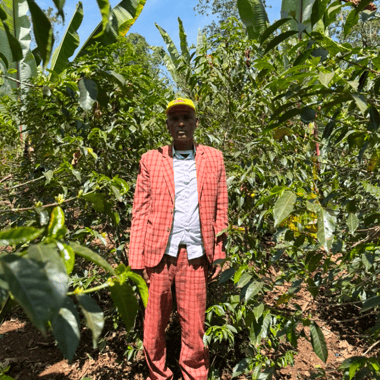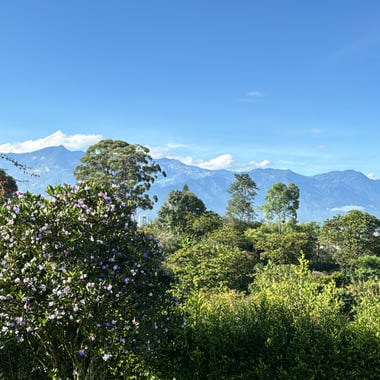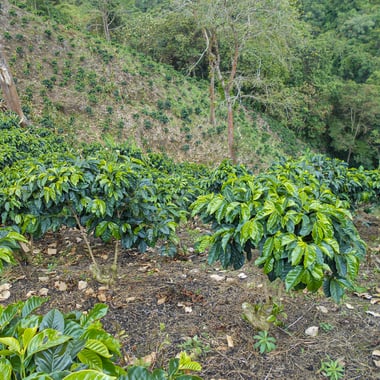
Switch-backing up mountainsides and across small hand-built log bridges, visiting Heza Washing Station at 1960 m.a.s.l can be likened to an off-road adventure. To say Heza Washing Station is ‘remote’ would be an understatement, and yet the community that lives in the surrounding hills is a special one, comprised mostly of coffee farmers. Heza means ‘beautiful place’ in Kirundi, the local language of Burundi. With panoramic views and an ever-changing East African sky, this washing station lives up to its name.
Heza Washing Station processes its coffee by pumping spring water from a nearby natural spring. During the washed process, freshly harvested cherries are delivered by coffee farmers to the Heza Washing Station, then floated and hand-sorted for ripeness upon arrival. The cherries are pulped and fermented for 36 hours. This fermentation takes place underwater, under a plastic tarp. After fermentation, the parchment is sometimes ‘footed.’ During footing, a team will agitate and dance on the slippery coffee parchment, helping to loosen any remaining mucilage clinging to it. It is then rinsed in fresh water, graded by density, and left to soak for another four to six hours in the final rinse tank.
The parchment is carried to covered drying tables, where it spends between six and 48 hours pre-drying. During this time, it is hand-picked for under-ripeness, over-ripeness, insect damage, and visual defects. It is then moved to traditional African-raised tables, where it slowly dries for 16 to 20 days (depending on the weather) until it reaches the ideal 10.5% moisture level. During the natural process, coffee cherries are floated and hand-sorted, then placed directly on the drying tables. The whole coffee cherry spends between 25 and 30 days drying in its own skin, slowly turning from a deep red to a prune-like purple- black once it’s fully dry and at the preferred 10.5% moisture level.
Gishubi is a stone’s throw away from the indigenous Kibira Forest. The cool mist of the forest breathes daily onto the coffee trees. This slightly cooler microclimate makes Gishubi coffee cherries grow and mature more slowly, which sets the Gishubi cup apart. Sadly, the hill’s proximity to the forest has made it a permanent theater of war during times of conflict. Armed groups have often hidden in the forest and forcefully collected people’s possessions, crops, and livestock. During times of conflict, farmers have no choice but to abandon their fields, and children cannot attend school.