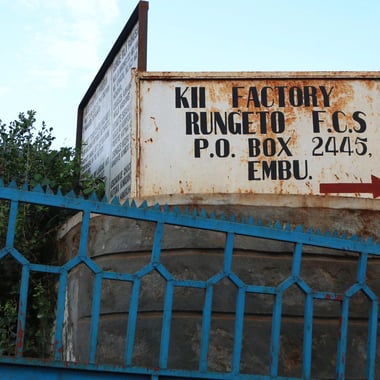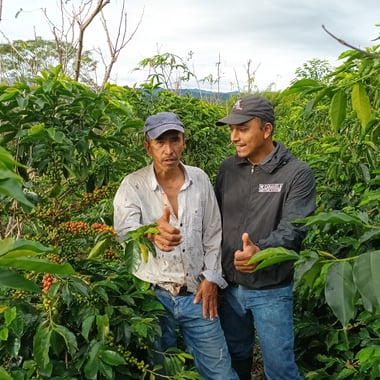
Spikes Estate owned by Manasseh Kiboch is located just east of Gitwe which is in the Gatundu South Sub County, and Ndarugo Ward County of Kiambu County, one of the best coffee growing regions in Kenya. It lies between 1700M and 1800 M above sea level. Manasseh Kiboch and his wife have been producing coffee since 2012 and are slowly but steadily growing their farm and land year on year now having more than 15 acers spread over 3 plots of land.
Soils and Climate
Spikes Estate lies in the coffee - tea transition zone close to the Aberdare range. Soils are red volcanic and well-drained; therefore, the climate is ideal for coffee production. Reliable bimodal rainfall and temperature range of 14-26 c.
Reliable bi modal rainfall of above 1400mm per annum is characteristic of these high altitude regions around the Aberdare Ranges, which are transition zones for coffee and tea. The long rains fall between March and May while the short rains come between October and December.
Processing
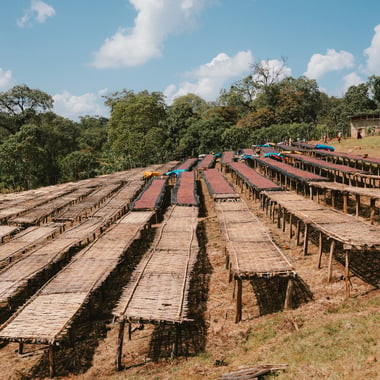
Some of its distinction can be attributed to topographic and climatic conditions, but as always, there are people engaged – from picking coffee cherries to processing; both crucial to the quality of the product. People make the difference. Cherry is selectively handpicked and then pulped in Mariri’s hand pulper. Coffee is dry fermented for 24 hours and, after being washed, soaks in clean water for a further 24 hours. Before the Wet parchment is moved to raised dry beds where they are dried for 10 to 18 days. Depending on the weather.
Management
Their farm manager Moses have been looking after their farm along side Manasseh since 2019, he as well looks after a neighbour Estate as well called Gifted. Besides growing coffee they also keep cows, and in December 2024 invested into getting Bio-Gas set up so he now can produce gas for home use as well. From the Cow manure and coffee pulp that wont be used as fertilizer to begin with.
Ecology
The area is rich in both terrestrial and aquatic ecosystem. Farmers are sensitized on the importance of preserving indigenous species. Species in the area include snakes, deer, hare, weaverbirds, owls and hawks among others. Additionally, numerous indigenous plant species like Fig, Cordia, Croton and neem trees are found in this region.